Sigma Lenses: Focus-Context Transitions Combining Space, Time and Translucence
Résumé
Focus+context techniques such as fisheye lenses are used to navigate and manipulate objects in multi-scale worlds. They provide in-place magnification of a region without requiring users to zoom the whole representation and consequently lose context. Their adoption is however hindered by usability problems mostly due to the nature of the transition between focus and context. Existing transitions are often based on a physical metaphor (magnifying glass, fisheye, rubber sheet), and are almost always achieved through a single dimension: space. We investigate how other dimensions, namely time and translucence, can be used to achieve more efficient transitions. We present an extension to Carpendale's framework for unifying presentation space accommodating these new dimensions. We define new lenses in that space, called Sigma lenses, and compare them to existing lenses through experiments based on a generic task: focus targeting. Results show that one new lens, the Speed-coupled flattening lens, significantly outperforms all others.
Domaines
Interface homme-machine [cs.HC]
Fichier principal
 sigmalensesCHI2008.pdf (3.49 Mo)
Télécharger le fichier
sigmalensesCHI2008.pdf (3.49 Mo)
Télécharger le fichier
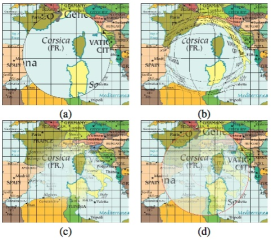 fig1.jpg (130.64 Ko)
Télécharger le fichier
fig1.jpg (130.64 Ko)
Télécharger le fichier
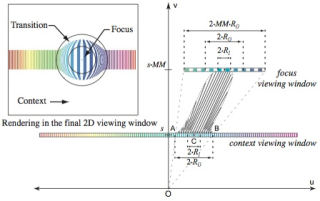 fig2.jpg (37.08 Ko)
Télécharger le fichier
fig2.jpg (37.08 Ko)
Télécharger le fichier
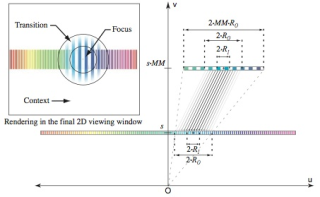 fig3.jpg (31.84 Ko)
Télécharger le fichier
fig3.jpg (31.84 Ko)
Télécharger le fichier
 fig4.jpg (82.32 Ko)
Télécharger le fichier
fig4.jpg (82.32 Ko)
Télécharger le fichier
 fig6.jpg (19.96 Ko)
Télécharger le fichier
fig6.jpg (19.96 Ko)
Télécharger le fichier
 fig9.jpg (70.22 Ko)
Télécharger le fichier
sigmalenses_chi2008.mov (30.01 Mo)
Télécharger le fichier
fig9.jpg (70.22 Ko)
Télécharger le fichier
sigmalenses_chi2008.mov (30.01 Mo)
Télécharger le fichier
Origine : Fichiers produits par l'(les) auteur(s)
Format : Figure, Image
Format : Figure, Image
Format : Figure, Image
Format : Figure, Image
Format : Figure, Image
Format : Figure, Image